Venice Beach did not become bodybuilding shorthand because a single person trained there. It became shorthand because a public place, a tight training scene, a few unusually visible athletes and a growing media machine reinforced one another. By the time people around the world associated Venice with barbells, physiques and California sunlight, the image had already become bigger than the beach itself.
Three names sit at the center of that public memory: Arnold Schwarzenegger, Franco Columbu and Lou Ferrigno. They were not the only bodybuilders connected to Venice, and they did not all represent the same kind of career. But together they gave the scene recognizable faces: the champion who crossed into film and politics, the close training partner and two-time Olympia winner, and the towering rival whose television role made the sport legible to an even wider audience.
- Why Venice was ready to become a symbol
- Arnold Schwarzenegger and scale
- Franco Columbu and the social training scene
- Lou Ferrigno and mass-media recognition
- How place, people and media reinforced one another
Venice was already a public stage
It is important not to confuse Venice Muscle Beach with the older Original Muscle Beach in Santa Monica. The Santa Monica tourism history notes that the original outdoor fitness culture began in the 1930s and that Venice’s Muscle Beach was established in 1963. That distinction matters because the Venice scene inherited an existing public appetite for strength, acrobatics and physical display; it did not appear from nowhere.
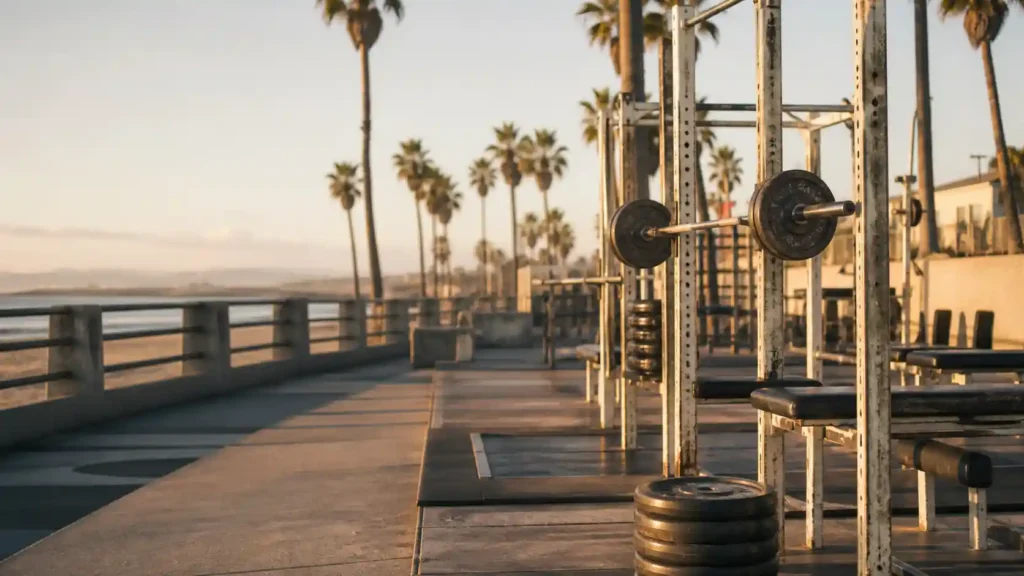
The beach setting changed the visibility of training. A private gym can create a serious local culture, but an outdoor weight area sits beside walkers, tourists, photographers and the wider entertainment world. The Santa Monica historical overview identifies Venice Muscle Beach as a home to bodybuilders including Arnold Schwarzenegger and Franco Columbu. Being seen was part of the setting, not an accidental side effect.
That visibility made Venice a useful meeting point between work and spectacle. The training was real, but so was the audience. That combination gave individual bodybuilders a backdrop that already looked like a story.
Arnold made the local scene travel
Arnold Schwarzenegger was not important to Venice simply because he had an exceptional contest record. His visibility made the location easier for the public to remember. A world-class physique, a strong on-camera presence and later work outside the sport gave people who did not follow bodybuilding a name to attach to the place.
Gold’s Gym describes its Venice roots through the athletes who trained there, naming Schwarzenegger, Lou Ferrigno and Franco Columbu among the bodybuilding figures who worked out at the original gym. This is brand history rather than a neutral archive, but it directly documents the association the gym itself presents. The Gold’s Gym account is useful because it shows how enduring that association remains.
For the competitive record behind the public image, read Arnold Schwarzenegger: The Kid From Austria Who Changed Fitness Forever. The larger Venice story is not that Arnold created the culture alone. It is that his later celebrity gave one local training environment a global reference point.
Franco made the scene feel like a working circle
Franco Columbu’s place in the Venice story is different. His two Mr. Olympia titles in 1976 and 1981 are fixed contest facts, but his cultural importance also comes from being remembered within the daily social world around Schwarzenegger and the broader California scene. He represented a different build, a strength-sport crossover and the familiar presence of a training partner rather than a lone celebrity on a poster.
That distinction helps explain why Venice is remembered as a community as much as a location. People trained together, compared standards and moved between outdoor platforms and indoor gyms. A serious environment is made by recurring people, not a logo on the door.
For the documented competition context, continue with Franco Columbu: The Strongman, Bodybuilder and Unlikely Champion. His story adds texture to Venice without requiring the false claim that every person in the scene followed one identical path.
Lou Ferrigno made the size visible beyond the sport
Lou Ferrigno gave the culture another public route. His physique was unmistakable within bodybuilding, and his role as the Incredible Hulk translated that presence to television audiences who may never have watched a physique contest. The association is not just fan memory: the Venice visitor guide identifies the outdoor Muscle Beach gym as a former home gym of Schwarzenegger and Ferrigno, while Gold’s Gym’s history ties the 1977 documentary Pumping Iron to Schwarzenegger and Ferrigno.
That media bridge mattered. A contest result reaches people who follow the contest. A film or television character gives a far broader audience a visual reference. Venice could then stand for a certain version of physical culture even to people who had never set foot in California.
Read Lou Ferrigno: From Bodybuilding Stage to The Incredible Hulk for the career story behind that bridge. The lasting point is cultural, not prescriptive: media exposure changes which athletes and places enter public memory.
A place becomes famous through repetition
Venice was never only a beach, and it was never only Gold’s Gym. The outdoor platform, the nearby gyms, contest preparation, tourism, photography and film gave the area several ways to be seen. Gold’s Gym’s Venice history describes the original gym as opening in 1965 and later receiving worldwide attention through Pumping Iron. The Gold’s Gym historical overview is a useful account of how the brand understands that transition from local facility to global identity.
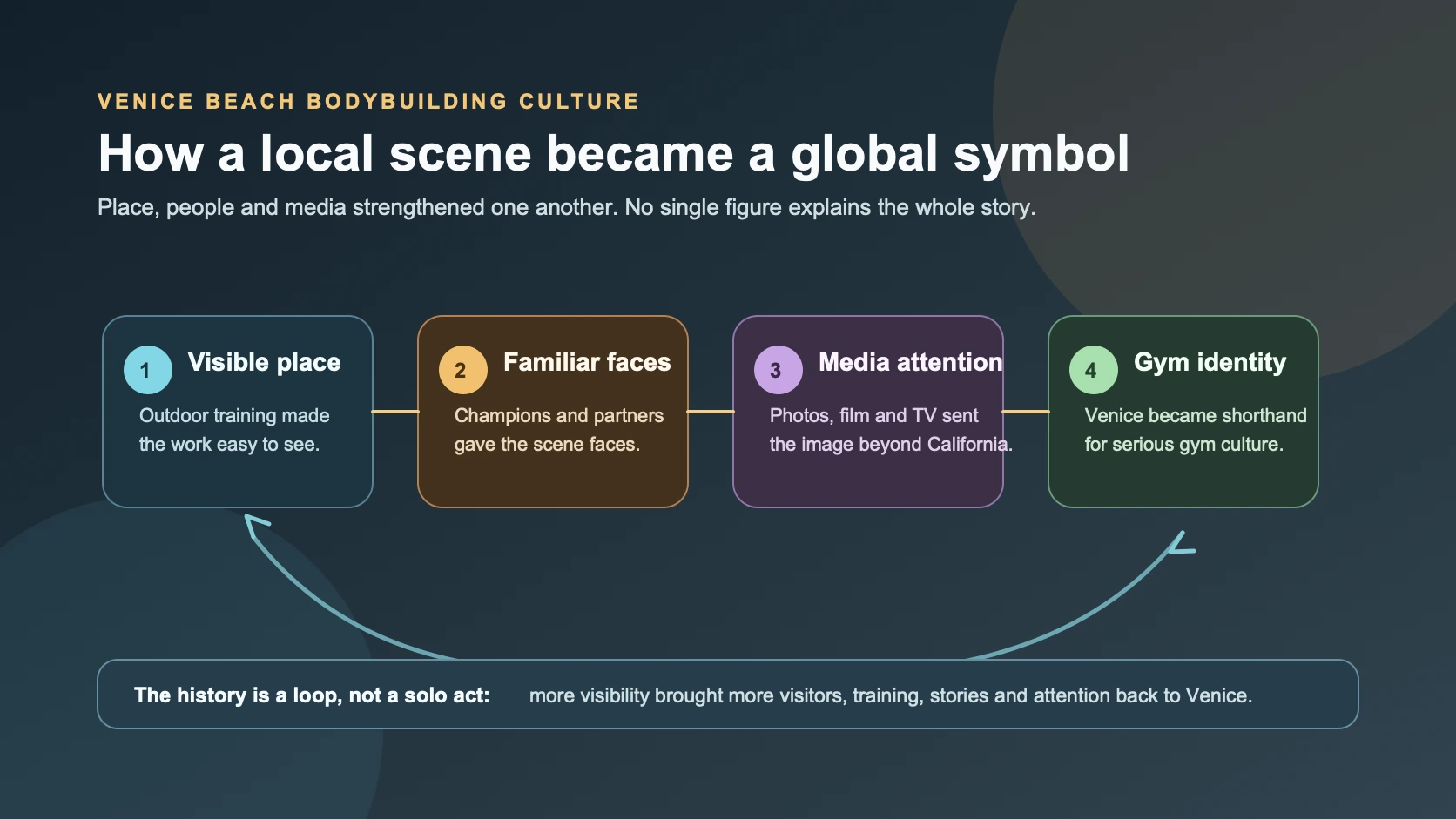
The three bodybuilders did not make Venice famous in isolation. They were representatives of an environment that had equipment, training partners, visibility and a growing audience. Their individual achievements made the environment recognizable; the environment made those achievements easier to picture.
That is the small useful lesson for an everyday lifter. You do not need Venice, fame or a famous training partner to benefit from a training environment. You need a place where effort is normal, standards are clear and people return often enough for progress to become visible. The scale is different. The social principle is not.
Conclusion
Arnold Schwarzenegger, Franco Columbu and Lou Ferrigno are remembered in the Venice Beach story because each gave the place a different public face: global celebrity, training-community texture and mass-media recognition. Together with outdoor Muscle Beach and the serious-gym culture around it, they helped turn a local scene into bodybuilding’s most durable visual shorthand.
Venice became famous through repetition: people trained, others watched, media carried the image, and the image brought more attention back to the place. That loop, not one perfect workout, is what made the legend travel.
FAQ
Did Arnold Schwarzenegger make Venice Beach famous by himself?
No. His visibility was important, but Venice already had public fitness culture and a wider group of bodybuilders, gyms, visitors and media around it. The location became symbolic through that combined scene.
Were Franco Columbu and Lou Ferrigno connected to Venice training culture?
Yes. Venice histories and Gold’s Gym’s own historical material associate both athletes with the area and the original Gold’s Gym scene. Their roles in public memory were different from Arnold’s, but both helped make the culture recognizable.
Is Venice still important to bodybuilding culture?
Yes as a symbol and a destination. The equipment and people change over time, but the association between Venice, outdoor Muscle Beach and the gym culture around Gold’s remains part of fitness history.
Continue with a related story
For the history of the places behind the image, read From Muscle Beach to Gold’s Gym: Where Modern Gym Culture Took Shape. For the social side of the golden-era training world, continue with Arnold and Franco Columbu: Friendship, Competition and the Golden Era.