Most lifters think about eggs in one line: protein. That is not wrong, but it is incomplete. Eggs do belong among the animal protein foods listed in the current Dietary Guidelines for Americans, 2025-2030, yet one reason they stay useful in real-world meal planning is that they bring more than a single macro to the plate.
For a beginner or intermediate lifter, that matters. A food can help your plan even when it is not a magic "muscle-building" ingredient. Eggs are a good example: they can make meals easier, add useful micronutrients, and pair well with foods that fill in the gaps. The biggest underrated pieces are choline, vitamin B12, and selenium.
This article is for healthy adults who want a practical nutrition lens, not a disease-specific prescription. The short version is simple: eggs can be a smart staple for lifters because they contribute meaningful choline, some B12, and some selenium, but they usually work best inside a bigger meal that also covers total protein, carbohydrate, fiber, and produce.
- Why eggs matter beyond protein
- What two eggs actually give you
- Why choline is the standout nutrient
- What B12 and selenium add for lifters
- How to build egg meals that fit training
Why eggs matter beyond protein
One reason eggs get flattened into "just protein" is that gym nutrition is often discussed in very narrow terms. People compare foods by grams of protein alone, then stop there. That is useful when you are trying to hit a daily target, but it misses how actual meals support training, recovery, and consistency.
The NIH Office of Dietary Supplements choline fact sheet notes that many people in the United States consume less than the adequate intake for choline. The same office’s vitamin B12 fact sheet and selenium fact sheet also make clear that these nutrients have clear physiological roles, even if they are not the first things people mention after a workout.
What two eggs actually give you
A practical way to think about eggs is not "Is this a superfood?" but "What does a normal serving contribute?"
Using NIH serving data for large cooked eggs:
- One large egg provides 147 mg of choline.
- One large cooked egg provides 0.5 mcg of vitamin B12.
- One large hard-boiled egg provides 15 mcg of selenium.
That means a two-egg serving lands around:
- 294 mg choline
- 1.0 mcg vitamin B12
- 30 mcg selenium

Placed next to adult reference intakes from NIH, that is meaningful. Choline adequate intake is 550 mg per day for men and 425 mg per day for women. Vitamin B12 recommended intake for adults is 2.4 mcg per day. Selenium recommended intake for adults is 55 mcg per day.
So two eggs can cover a large share of daily choline needs, around two-fifths of the adult B12 target, and more than half of the selenium target. That is the real nutrition case for eggs in a lifting diet: not that they solve everything, but that they move several useful needles at once.
Two eggs are a meaningful micronutrient food, but they are not automatically a full post-workout meal. Their best use is often as a base that you build around.
Why choline is the standout nutrient
If there is one underrated reason eggs keep showing up in evidence-based nutrition conversations, it is choline.
According to the NIH choline fact sheet, choline is an essential nutrient involved in cell-membrane structure, lipid transport and metabolism, and the production of acetylcholine, a neurotransmitter used in memory, mood, and muscle control. The body can make some choline, but not enough to fully cover human needs. That is why diet still matters.
For lifters, the practical point is not that eating eggs gives you an instant performance spike. The useful point is that training places repeated demands on tissues, movement, and recovery, and eggs are one of the more efficient whole-food ways to push daily choline intake in the right direction. NIH also notes that eggs are one of the richer common food sources of choline, with one large hard-boiled egg listed at 147 mg.
What B12 and selenium add for lifters
Vitamin B12 is another reason eggs are more than a protein delivery system. The NIH vitamin B12 fact sheet explains that B12 helps keep blood and nerve cells healthy and helps make DNA. Natural B12 is found in foods of animal origin, including eggs and dairy.
For lifters, that does not turn eggs into an "energy hack." It simply means eggs contribute to a nutrient that supports normal physiological functions you absolutely do not want to underserve while training hard. A two-egg serving gives you about 1 mcg of B12, which is useful, but also shows why eggs are support players rather than a complete answer. If someone has low B12 intake overall, follows a diet with few animal foods, or has absorption issues, eggs alone may not close the gap.
Selenium is the third piece people rarely associate with eggs, even though it is one of the cleaner practical arguments for including them. The NIH selenium fact sheet explains that selenium is a constituent of selenoproteins, which play roles in thyroid hormone metabolism, DNA synthesis, reproduction, and protection from oxidative damage and infection. One large hard-boiled egg provides 15 mcg, so two eggs get you to about 30 mcg.
Again, the smart interpretation is moderate. Selenium is not a hidden anabolic switch. But if a common breakfast food helps cover over half of the adult selenium target while also bringing protein and choline, that is a meaningful contribution to diet quality.
How to build egg meals that fit training
The main limitation of eggs for lifters is not that they are low quality. It is that many people stop the meal too early.
The International Society of Sports Nutrition position stand on protein and exercise notes that general meal-level recommendations for athletes often fall around 20-40 g of high-quality protein. That is why eggs frequently work better as part of the protein strategy than the entire strategy.
In practice, that can look like:
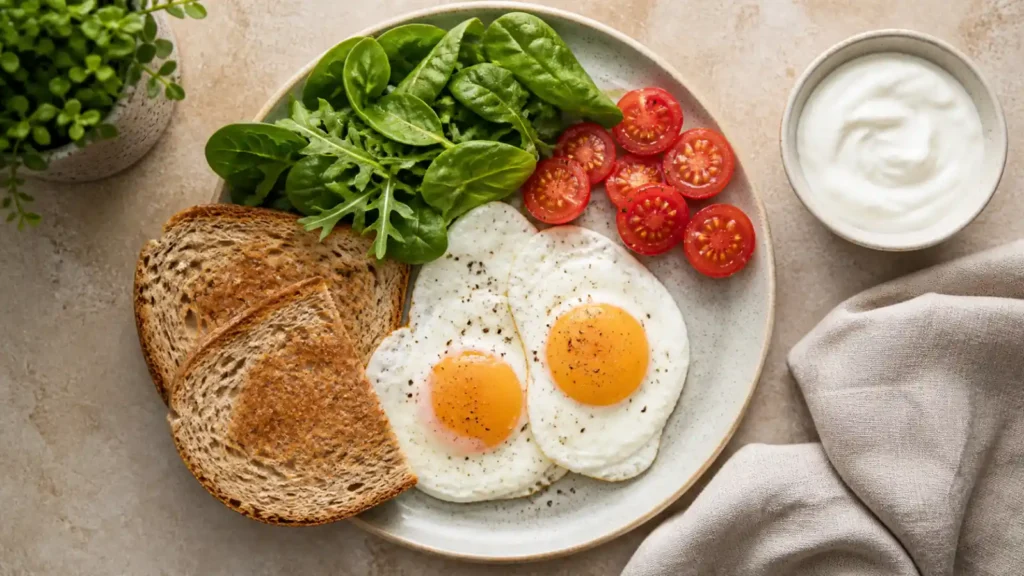
- eggs plus Greek yogurt and fruit for a higher-protein breakfast;
- eggs on toast with cottage cheese and tomatoes;
- an omelet with potatoes, vegetables, and a side of skyr;
- eggs with rice and beans when you want a simple meal with both protein and carbohydrate.

Those combinations do a few things well. They keep the convenience of eggs, increase total protein when needed, add carbohydrate for training fuel or recovery, and make it easier to cover fiber and produce. They also help prevent the classic nutrition mistake of treating one food as if it has to do every job.
If your meal already includes enough protein from another source, eggs can still add value through taste, texture, and micronutrients. If your meal is light on protein, eggs can be the starting point and not the finish line.
If you have an egg allergy, a diagnosed lipid disorder, a gastrointestinal condition, or specific medical advice about dietary cholesterol or food tolerance, individual guidance matters more than general fitness content. Follow the advice provided by your qualified healthcare professional.
What eggs do not do
Eggs do not replace total daily protein targets. They do not make vegetables optional. They do not compensate for chronically low calorie intake, poor sleep, or inconsistent training. And they should not be sold as a mandatory food for body composition success.
They are also not the only route to the nutrients discussed here. Choline, B12, and selenium can come from other foods too, and a good diet pattern always has more variety than one item repeated on autopilot.
What eggs do offer is a strong cost-to-benefit profile: easy prep, broad meal use, helpful micronutrients, and enough flexibility to fit cutting phases, maintenance phases, and higher-calorie periods. For most healthy lifters, that is a better reason to eat eggs than any dramatic claim about "perfect muscle food."
Continue with a related guide
For the next practical step, read Greek Yogurt: The High-Protein Food That Also Brings Calcium, B12, Iodine and Potassium. For a second perspective from the same topic cluster, continue with Lean Beef vs Chicken: Which Makes More Sense for a Strength Athlete?.
Conclusion
Eggs deserve more credit than "they have protein," but less hype than they usually get online. Their real value for lifters is practical: they contribute meaningful choline, some vitamin B12, and useful selenium in a food that is easy to cook, easy to combine, and easy to repeat.
That said, eggs are usually most useful when you stop expecting them to do everything alone. Use them as part of a meal that also covers total protein, carbohydrate, fiber, and produce, and they make much more sense in a training diet.
FAQ
Are eggs enough protein for a lifting meal on their own?
Sometimes, but often not if you are trying to build a clearly protein-forward meal. The ISSN position stand points to a general 20-40 g meal range for many athletes, so eggs often work best with another protein source instead of acting alone.
How many eggs make a useful difference for choline?
Even one large egg matters because NIH lists it at 147 mg of choline. Two eggs get you to about 294 mg, which is a large share of the adult adequate intake, especially for women.