
The first strength program should not need a reveal trailer. It should be easy to explain, easy to set up, and slightly repetitive by design. That can feel disappointing when fitness content presents novelty as expertise. New exercises look interesting. New splits feel purposeful. A complicated spreadsheet can make a beginner feel as if they have found the serious version of training.
But novelty has a cost. When exercises, rep ranges, weekly schedules, and effort targets all change at once, you lose the ability to tell what is happening. Did your squat improve because you got stronger, because the depth changed, because the rest was longer, or because this week used a different variation? Did the session feel hard because the dose was useful, or because nothing about it was familiar yet?
For a beginner, a boring program is not a lazy program. It is a program that creates enough repeated exposure to learn movements, compare sessions, and make sensible adjustments. The ACSM progression models position stand describes progression as a planned manipulation of training variables. You can only manipulate a variable intelligently when the other important pieces are reasonably stable.
- What “boring” actually means in a beginner program
- Why repetition improves skill and decision-making
- How to build a small session that has a clear purpose
- When to keep, adjust, or replace an exercise
- How long a simple program deserves before judgment
Boring means stable, not mindless
A boring first program does not mean doing the exact same lift forever or ignoring discomfort. It means holding the main structure steady for long enough to learn from it. You may use a squat pattern, a press, a pull, and a hinge for several weeks while changing only small details: a rep, a little load, a range of motion, or one accessory movement.
The stability gives you three useful things: practice, comparison, and predictable recovery.
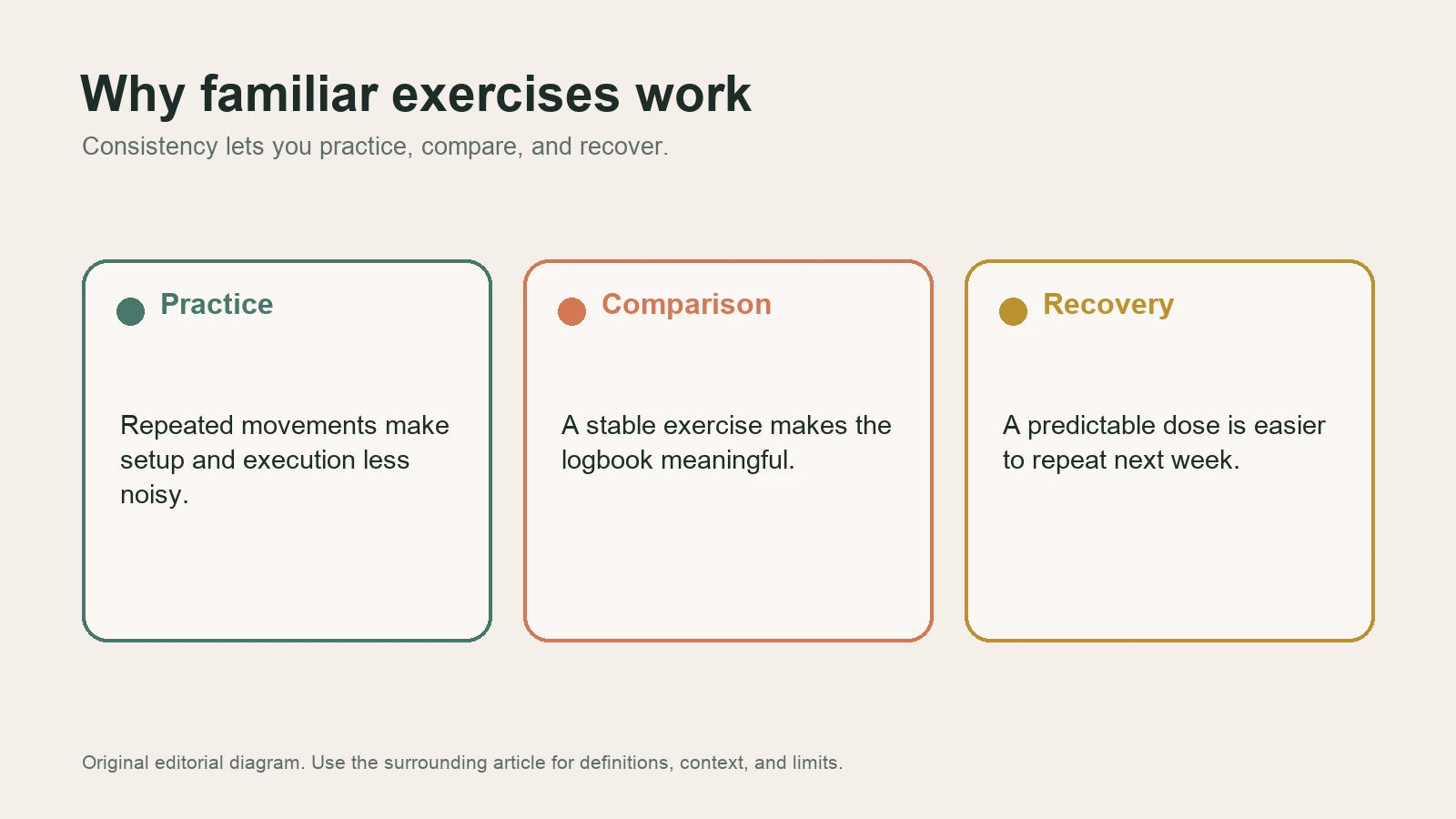
Practice matters because strength is not just muscle size. The nervous system and the movement pattern both adapt to what you repeat. Our article on how strength develops explains why early improvements often include coordination and skill. A familiar row lets you learn how your torso position, grip, and range of motion affect the rep. A new row every week restarts part of that learning process.
Comparison matters because a log only becomes useful when the work is comparable. If you used the same machine setup, load, and rep range, you can look back and see whether you completed more controlled repetitions or whether the same work felt less disruptive. That is more useful than remembering that one session felt “intense.”
Recovery matters because a stable dose shows you what you can actually tolerate. A session that changes every time can conceal whether you are adding too much work, training too close to failure, or simply underestimating how long a demanding lower-body movement takes to recover from.
The program should have fewer moving parts than your week
Most beginners do not need a six-day split, a rotation of specialty bars, or a long list of isolation exercises. They need a schedule that survives ordinary work, travel, sleep disruption, and competing priorities. Two or three full-body sessions are often a practical first choice because they provide repeated exposure without requiring the gym to dominate the week.
The exact split is less important than the weekly work you can perform and recover from. A 2024 systematic review comparing split and full-body routines found similar strength and hypertrophy outcomes when training volume was equated. That does not prove every split is equal for every person. It does mean a beginner can choose the structure that is easier to show up for instead of treating one format as mandatory.
Use a small session with distinct jobs:
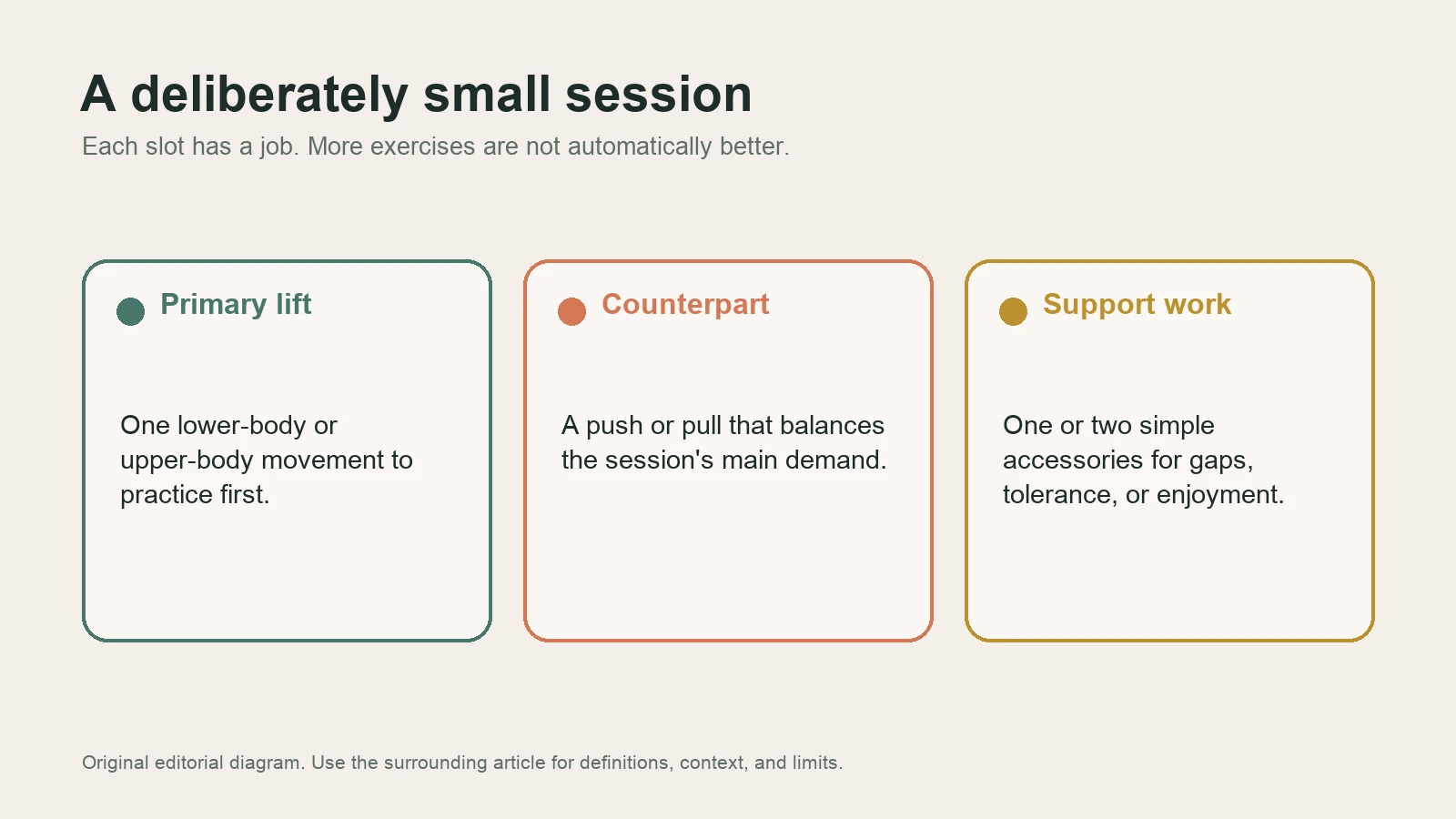
| Part of the session | Purpose | Example choice |
| — | — | — |
| Primary lift | Practice the movement that matters most today | leg press, goblet squat, dumbbell bench press, row |
| Counterpart | Add a complementary push, pull, hinge, or knee-dominant pattern | pulldown after pressing, Romanian deadlift after a row |
| Support work | Address a limited need without taking over the session | calf raise, carry, simple trunk work, arm work you enjoy |
This framework lets you keep the structure while using accessible variations. A machine chest press can be a valid primary press. A goblet squat can be a valid squat pattern. A chest-supported row can be more repeatable than a free-standing row for someone still learning to brace. The goal is not to earn a more advanced variation. The goal is to perform useful work with a setup you understand.
Progression should be deliberately unexciting
The best early progression is usually a small one. Pick a range such as eight to twelve repetitions. Use a weight you can control. Try to add a repetition over one or more sessions while maintaining a similar range of motion and setup. When you can repeatedly reach the upper end of the range, add the smallest available load increase and return to the lower end of the range.
That is progressive overload in a beginner-friendly form: a planned change that preserves enough of the session to make the result interpretable.
This approach is not magic. It is valuable because it is legible. You know what “better” looks like before the session starts.
The 2023 network meta-analysis on resistance-training prescription found that multiple combinations of load, sets, and frequency can improve strength in healthy adults, with higher-load prescriptions tending to maximize strength gains. Beginners should not turn that finding into a demand to lift at their current maximum. It is a reminder that load matters, but so do safe setup, progressive exposure, and the ability to keep training.
Avoid adding load when the only evidence is impatience. If the new weight changes the range of motion, makes you rush the repetition, or forces you to guess at technique, it may be more useful to keep the current load and build another clean repetition.
There is another practical advantage to this slower rule: it gives you a fallback on difficult weeks. If sleep, work, or travel disrupts the week, you can repeat the previous successful prescription rather than deciding the plan has failed. The log still has meaning because the exercise and target are familiar. A program that can absorb an ordinary bad week is usually more useful than one that only works when every session feels perfect.
For the same reason, do not change an exercise and a progression rule together unless there is a clear reason. If you replace a dumbbell press with a machine press, treat the first few exposures as new data. Do not expect the old numbers to transfer exactly. Stability is not about refusing to change; it is about making each change interpretable. That restraint protects the signal in your log.
Keep, adjust, or replace: use a real decision rule
An exercise deserves to stay when it is tolerated, practical, and showing a useful trend. It deserves adjustment when you have repeated it honestly and a specific constraint is obvious. It deserves replacement when the variation cannot be made comfortable, accessible, or repeatable.
Keep an exercise when:
- you can set it up consistently;
- the movement is comfortable during and after training;
- you can see a gradual improvement in reps, load, control, or confidence;
- it fits the equipment and time you actually have.
Adjust an exercise when the problem is narrow. Perhaps the grip is uncomfortable, the range of motion is too ambitious, the rest periods are too short, or the current set target is creating rushed reps. Change one thing and see whether the problem improves.
Replace an exercise when it repeatedly produces sharp pain, symptoms that worsen, or a setup problem that you cannot solve safely. Replacement is not failure. The movement pattern can usually be trained through another tool or variation. If you are unsure why pain or symptoms are occurring, seek an individual assessment rather than trying to force a generic program to diagnose the problem.
Give the plan enough time to reveal a pattern
How long should you run a simple program? Long enough to learn the exercises and observe a trend, but not so long that you ignore clear evidence that it does not fit. For many beginners, six to eight weeks of consistent exposure is a reasonable first observation window. That is not a promise that every movement will improve on a weekly schedule. It is enough time to distinguish one bad day from a pattern.
During that window, do not judge the program solely by whether every session feels exciting. Judge it by practical outcomes: Did you attend? Can you explain what you did? Are the main movements becoming more controlled? Are you recovering in time for the next session? Does your log show a small positive direction?
A first strength program should make your next session obvious. That is its quiet advantage. When the basic plan has done its job, you will have the skill and data to decide whether you need more volume, a different frequency, a new goal, or simply another block of the same useful work.
Continue with a related guide
For the next practical step, read Three, Four or Five Days? Finding the Training Frequency That Fits Your Life. For a second perspective from the same topic cluster, continue with The Anatomy of a Great Strength Program.