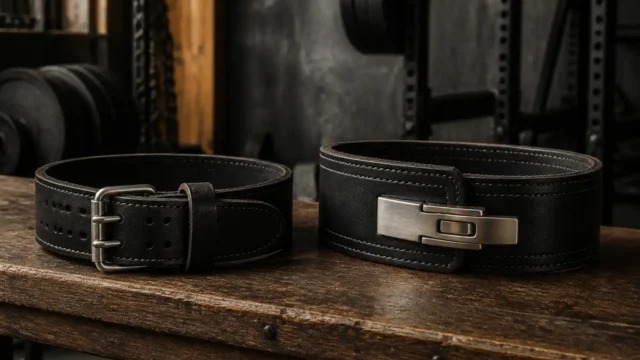
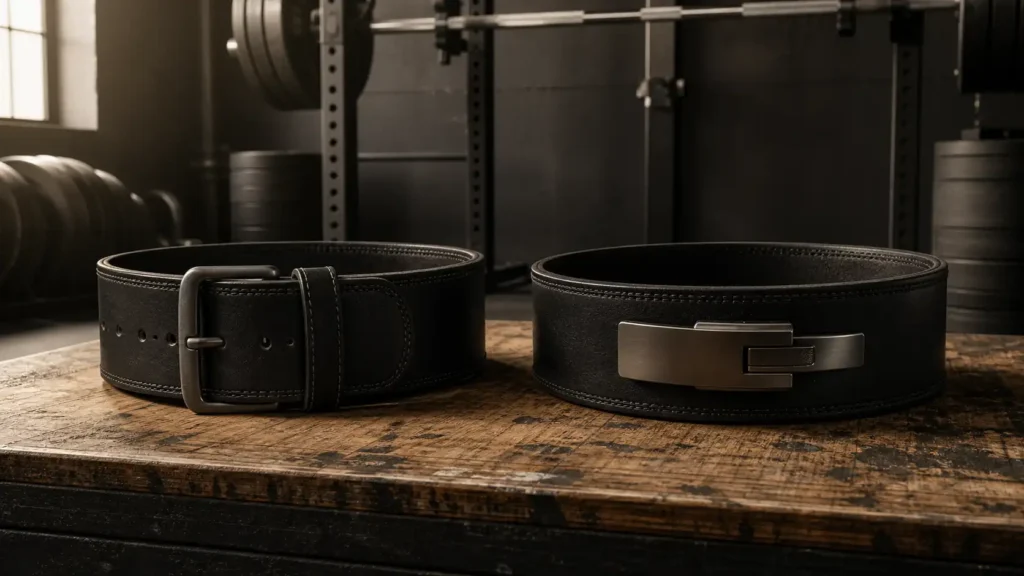
The lever-versus-prong debate often gets framed as a question of which belt is more serious. It is not. Both closures can hold a belt firmly around the torso. Neither closure makes a lifter stronger by itself, and neither fixes a belt that is the wrong width, thickness or shape for the lift being trained.
The practical difference is simpler: a lever prioritizes a fast, repeatable close at a chosen setting; a prong prioritizes small, easy adjustments from one fastening to the next. The better choice is the one you can place, tighten and release reliably without making the rest of your setup more complicated.
This is a general gear guide, not medical advice. A belt is not a response to pain, numbness, weakness, breathing difficulty or a recent injury. If a symptom changes how you train, get individual guidance instead of treating a closure change as a solution.
- What both closures actually do
- When a lever closure makes sense
- When a prong closure makes sense
- Why fit can change across a training day
- Competition rules and a simple test process
The belt has the same job either way
A lever belt and a prong belt can be made from the same leather, be the same width and have the same thickness. The closure is one part of the construction. It changes how you arrive at a given tension; it does not automatically change the quality of your brace, the value of your program or the suitability of the belt for every movement.
That distinction matters because gear shopping likes simple rankings. A lever is not automatically more secure because it closes with a click. A prong is not automatically less refined because you feed it through a buckle. A worn belt, damaged hardware or a poor fit is a problem regardless of the mechanism.
Start with the basics in Lifting Belts 101: a belt should have a clear role in a familiar lift, allow you to take a deliberate breath and brace, and stay in a position you can reproduce. Once that is true, the closure question becomes much easier to answer.
Lever closures favor a repeatable setting
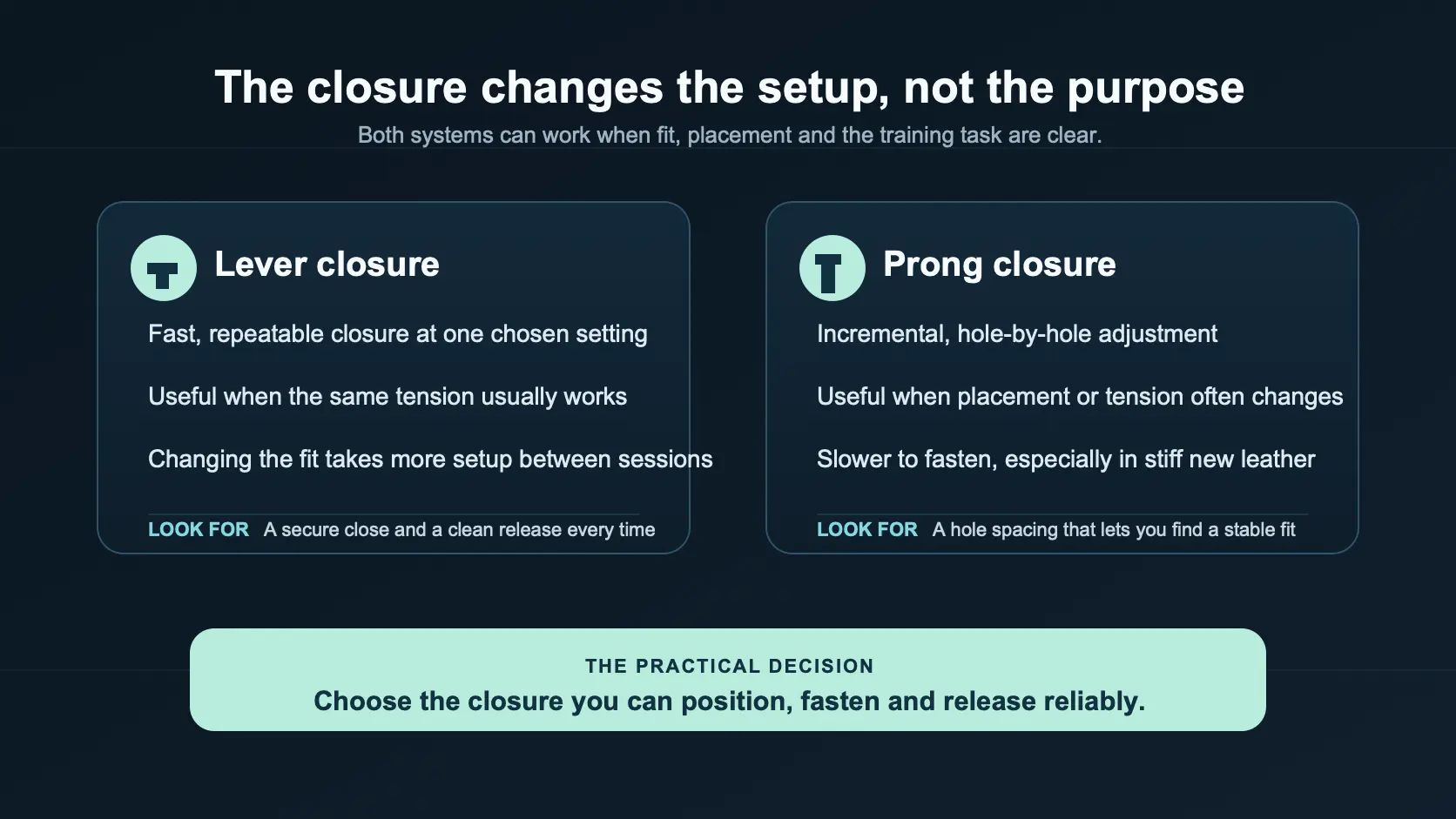
A lever is set to a particular hole or position, then closed with a mechanical latch. Once it is adjusted correctly, you can usually close it quickly and return to the same tension from set to set. That repeatability is the main appeal. It can be useful when one placement and one tension work consistently for your primary lift.
For a lifter whose competition-style squat setup rarely changes, this can make the pre-lift routine pleasantly boring: place the belt, set the usual position, close the lever and move on. It also tends to release quickly after the set. Those are workflow advantages, not proof that a lever makes the belt more effective.
The tradeoff is adjustment. If you want the belt tighter or looser, changing the lever’s setting normally takes more effort than moving a prong one hole. The exact process depends on the hardware, but it may mean opening the lever mechanism and resetting its position. Do that calmly before training, not by forcing hardware between sets.
Prong closures favor small adjustments
A prong belt fastens through a series of holes. The process can take a little longer, especially when the leather is new and stiff, but the adjustment range is direct. Want a slightly different fit for a deadlift than for a squat? Want a little more room after a meal, a long warm-up or a change in placement? Move to another hole and see whether the setup remains repeatable.
That flexibility is why a prong belt can suit lifters who use one belt across several movements or who are still learning where it sits best. A single-prong model is often straightforward to handle. Double-prong models may spread the fastening force across two prongs, but they also require two holes to line up; they are not inherently a better choice just because they look more substantial.
The downside is not a safety defect. It is simply friction in the routine. Threading and fastening a stiff belt takes more attention than closing a pre-set lever. If you dislike that process enough that you rush your setup or avoid using a belt where you planned to use it, the supposed flexibility is not helping.
A fit can change without either system being wrong
There are ordinary reasons a belt setting may feel different across a day or week. Your placement can move slightly between a low-bar squat and a conventional deadlift. A change in clothing, warm-up time, food or general comfort can make the familiar hole feel different. That does not make a prong closure superior, and it does not mean a lever user has made a mistake. It only tells you that the closure should match how stable your preferred setting actually is.
Before treating closure as the first decision, compare the other belt variables. The framework in 10mm or 13mm? Choosing a Belt Without Overthinking It explains why thickness changes the feel of a belt but does not create a status hierarchy. Width, leather stiffness, edge shape and the space between your ribs and hips can matter more than the buckle.
If you are deciding whether a belt belongs in your training at all, read When Should a Lifter Start Using a Belt? first. A closure choice becomes useful only after the belt has a defined job in a familiar movement.
Competition rules are a boundary, not a verdict
If you plan to compete, the federation rulebook is more useful than a retailer category. The current IPF Technical Rules allow one- or two-prong buckles and quick-release mechanisms, commonly called lever closures, within that rule set’s belt requirements. The same rulebook also regulates dimensions, while the approved-equipment list can determine whether a specific item is allowed.
Treat that as an example, not a universal answer. Federations, divisions and meet directors can use different rules or approved lists. Check the current rules for the exact event before purchasing a belt specifically for competition. A closure being generally permitted does not confirm that every brand, model or configuration is approved.
Test the decision with familiar training
The cleanest way to choose is to reduce the variables. If you can try both systems, use a lift you already know and comparable working sets on separate sessions. Keep placement, width and general belt fit as similar as possible. Notice a few practical details: can you fasten it without rushing, take the brace you intend, complete the planned repetitions and release it comfortably afterward?
Do not judge the closure during a maximal attempt or on the first day you wear a very stiff belt. A new belt, fatigue and an unfamiliar setup can all make a normal training session hard to interpret. Give the system enough ordinary exposures to learn whether it becomes routine.
This approach also keeps the decision in proportion. The question is not which buckle identifies you as a serious lifter. The question is which system makes a known piece of training easier to repeat. The broader discussion in The Belt Question: When Does It Actually Make You Stronger? keeps that point connected to a specific training task rather than a gear identity.
Choose the closure that removes friction
Choose a lever if you have found a stable placement and tension, value a quick repeatable close, and do not expect to alter that setting often. Choose a prong if you want simple incremental adjustments across movements or days and do not mind taking a little more time to fasten it. Both can be durable, useful options when the belt fits and the hardware is in good condition.
The answer is not hidden in the buckle. It is in your actual setup. Pick the closure that lets you prepare for the lift without making the belt the most complicated part of the session.
FAQ
Are lever belts faster than prong belts?
They are usually faster to close and release once the lever has been set to the right position. Changing that position generally takes more setup than moving a prong to another hole.
Are prong belts less secure than lever belts?
Not by default. A properly fastened prong belt with sound leather and hardware can be reliable. The mechanism alone does not guarantee fit, condition or useful setup.
Can I compete with either a lever or prong belt?
Often, but the exact answer depends on the federation, division, current rulebook and any approved-equipment list. Check the requirements for your actual meet before relying on a belt.
Continue with a related guide
For width, thickness and fit basics, read Lifting Belts 101: What They Do, What They Don’t and How to Choose One. For a practical look at the role of a belt during training, continue with The Belt Question: When Does It Actually Make You Stronger?.